Search in our blog

Custom Search

Saturday, May 11, 2013

Rufous-tailed attraction arrival!

Rufous-tailed scurb robins are probably the latest arriving migrants in Attica. This year, however, they came almost 10 days earlier than usual, and on the 10th of May singing males had already occupied their traditional territories!

One of the rarest breeders, they have declined in numbers in the last years, being common only in the agricultural land around the airport. The reasons for their decline are not known, as their breeding grounds are still in a very good condition.

Thursday, May 02, 2013

Citrine Wagtai at Vravrona!

While looking for Turtle Doves and Bee-eaters at the fields of Vravrona, I came across a much more unusual species; a Citrine Wagtail was feeding on the banks of Erasinos river, being very tame and offering me the chance for a great photo shooting!


Citrine Wagtail records have increased greatly in Attica in the last few years, and it seems to be a regular, though very scarce, passage migrant. Schinias is the most reliable site so far, and apart from Vravrona there are also records from the Spata fields (when flooded) and Oropos Lagoon. Hope the next one will be a bright male!


Wednesday, May 01, 2013

Seeing a Middle Spotted Woodpecker has become a real "piece of cake"!


Middle Spotted Woodpeckers are quite common and widespread, found in most of mainland Greece (including the Peloponnese) and the islands of Lesvos and Chios. However, their observation can be very hard, as they tend to hide in the dense foliage, never coming out in the open for long.
Therefore, when we first heard about a pair breeding at a large square in the city of Tripolis in the Peloponnese, we were surprised! 
The surprise was even bigger when we found out that they had their nest in a tree standing in the center of a popular cafeteria! 
Soon, the place got crowded with birders and photographers from all over Greece! The waiters of the cafeteria were very helpful, even putting tables in the best location so as to be able to drink your coffee (or eat your cake...) and take photographs at the same time!


Monday, April 29, 2013

Lesvos, Spring 2013, part I

Lesvos island is birders' paradise, from mid april until the first couple of weeks of May.
This year, the highlights so far are the two male White throated Robins (Irania guttularis), seen close to Sigri, at the Petrified forest. This year, the species was observed and photographed by various birdwatchers.
The following pica are all provided by fellow birder, George Alexandris.

White Throated Robin

Isabelline Wheatear
Masked Shrike

Cinereous Bunting

Kruepper's Nuthatch

Saturday, April 27, 2013

The wonder-pond οf Loutsa

The small wetrland of Loutsa in the east coast of Athens, has offered quite a few amazing sightings for its size. Kittlitz's Plover and Pectoral Sandpiper have been observed (the former being the only record for Greece). Among the more regular visitors, Red Knots and Broad-billed Sandpipers are very important, along with Temmink's Stints. The aforementioned birds are usually seen from a distance of 20-50 meters, not offering close-up photos. There is, however, a very small brackish pool just in front of the wetland, where birds can be seen and photographed (when been inside a car) from a distance of no more than 5 meters!

Wood Sandpipers are most probably the most common passage waders in April 

A Sanderling is not common at all in spring, being also rather scarce in winter

Marsh Sandpipers are regular, though scarce, in spring

Sunday, April 21, 2013

Migration at full speed Part II

Wetlands are not the only places to witness migration. Mt Hymettus is also full of migrant passerines, resting and feeding on their way to the north...Nightingales, Whitethroats and Flycatchers (Pied and Collared) along with Wood and Willow Warblers are seen in good numbers. Cuckoos are also seen quite easily, especially in caterpillar-rich areas, like maquis.

Cuckoos are fond of caterpillars found on dense maquis scrub
Female Collared Flycatchers are less striking that their male counterparts, and harder to tell

Common Whitethroats are not shy and frequently forage out in the open


Saturday, April 20, 2013

Migration at full speed Part I

 From the 15th to the 30th of April, spring migration is at its peak in Athens. The strong winds have brought quite a few interesting species; hundreds of Ruffs and Wood Sandpipers in Schinias marshes and Spata flooded fields, along with  Marsh Sandpipers, Spotted Redshanks and several Little Stints.  The first groups of Squacco Herons and several Purple Herons can be also easily seen, while huge flocks of swallows and martins feed on insects over the wetlands. Pallid and Montagu's Harriers are also regular.

Pallid Harrier over the flooded Spata fields
An already moulted Spotted Redshank, a really rare view of that plumage at Schinias Marshes

The first Whiskered Tern for thus year, feeding on insects at Spata fields


Monday, April 15, 2013

A realy busy weekend

It's mid April and migration is reaching its peak. After a few days of rather few newcomers, last weekend (13-14th) was really rewarding. Montagu's and Pallid Harriers along with the first Red-footed Falcon and Hobby were soaring in the fields of east Attica. The first flock of Bee-eaters (c.50 birds) was also seen flying low above Vravrona and Marathon. Black-eared Wheaters have taken position at their breeding grounds, while the flooded Spata fields are again offering food and shelter to many waders like Wood, Green and Marsh Sandpiper, Ruff and Black-winged Stilts. A single Collared Pratincole was also seen there along with lots of Red-throated Pipits and Yellow wagtails of several races. The most remarkable sighting, though was the Spoonbill found at Schinias National Park, together with a flok of Glossy Ibis and Ferruginous Ducks. And, the best is yet to come!

Red-footed Falcons are usually ariving in the end of the month,  so this is a quite early sighting

Pallid Harriers have become common sightings every spring

Black-eared Wheaters are common in rocky terrain all over Attica

Friday, April 05, 2013

Athens specialties are back!

Two small passerines are among the most wanted species of every European birdwatcher coming to Greece; Ruppell's Warbler and Cretzschmar's Bunting. Both can be quite easily seen very close to Athens, within a 30' min drive trip! The first birds for 2013 have been already seen in their regular sites.

Ruppell's Warbler are common, yet local, breeders, found in good numbers in Mt Hymettus. They prefer dense maquis scrub, avoiding woodland or phrygana.


Cretzschmar's Buntings are widespread and locally abundant summer visitors. Their melancholic song is echoing in many bare slopes of Attica

Friday, March 29, 2013

Limnos Island breeding attractions

Limnos island is located in the middle of Northern Aegean. Although it lacks the popularity of Lesvos, many interesting species can be seen during both migration periods, and it also hosts quite a good number of breeders of birdwatcing concern.

Northern Wheatears in Limnos frequently nest in rooftops of houses, a unique habit for Greece
Lesser Kestrels are nesting in many villages of the eastern part

Stone Curlew breeding population is very large, especially in the northern hilly country

Wednesday, March 27, 2013

Rarities in Athens: Cream coloured Courser at Spata fields

Photo kindly provided by Nikos Fokas Photography Blog
This Cream coloured Courser was observed only for 3 days at Spata fields, Athens!!!

Tuesday, March 26, 2013

Breaking News! Blue-cheeked Bee-eater in the Peloponnese!


Blue-cheeked Bee-eaters are rare vagrants, with most of the birds seen in Crete and Greek islands adjacent to Turkey. Mainland records are extremely rare (if any). Therefore, the bird that was seen on the 25th of March near the marshes of Nea Kios, close to the town of Nafplio, attracted any available birdwatcher around! The bird is quite tame, but can be seen only early in the morning or in the afternoon, as it seems to prefer a particular patch for roosting. Let's hope that it will stay for a few more days, so that every visiting birdwatcher can see it!

Sunday, March 24, 2013

Great Spotted Cuckoos are back!


Once very rare and local, the Great Spotted Cuckoo has become regular and widespread summer visitor in Athens. Favoured by the large increase of Magpie population, a good number of pairs can be seen in various sites around Athens, especially in the Mesogeia Plain. I think that this is the only positive contribution of the Magpies in biodiversity of Attica...

Friday, March 22, 2013

Η αποικία των σταχτοτσικνιάδων στην Κουλούρα Ημαθίας άρχισε  να γεμίζει . 83 φωλιές  έχει.

Monday, March 18, 2013

First wave of migrants has arrived!

The strong southern winds of the previous days have brought quite good numbers of migrants in Greece. Swallow and House Martin flocks are quite regular now, and the first groups of Yellow Wagtails are found in coastal and agricultural areas. Singing Hoopoes are now easy to see and hear, while the first Balkan Warblers are found among the still much numerous Chiffchaffs.Little Crakes have also arrived, along with Wood Sanpipers and Black-winged Stilts. 

Balkan Warblers are quite common in March

Not very shy but rather unobtrusive, the Little Crake is also an early arrival

The first Hoopoes usually come by late February, however it becomes common in mid March

Saturday, March 16, 2013

Athens Farmland Birds: Corn Bunting


Even though Athens and the Prefecture of Attica have a population of 4,000,000 people and the population density is more than 1,000 people/sq.km, there are still large tracts of agricultural country. Cultivations are usually mixed, olive, pistachio and fig groves with vineyards being at the same or adjacent field. This is very beneficial for farmland birds, along with the restricted use of agrochemicals. However, the most serious problem is the loss of agricultural country as settlements expand. Breeding Corn Buntings are still found in many parts of Attica, especially in the north and west. Populations in the east are fragmented, with the bulk found around Spata area, close to the airport. The species is still much more common in winter, large flocks can be seen flying even above the city centre.

Tuesday, March 12, 2013

The first Subalpine Warbler for 2013

This year, spring has come really early, even for a Mediterranean country like Greece. House Martins, Swallows and even Ruppell's Warbler were first seen in February! Now, as many as 5 Subalpine Warblers were singing today (12/3) in a scrubby hill close to the village of Erythres in west Attica. Hoopoe was also present, along with resident Sombre Tits and Great Tits. 

Subalpine Warblers are typical of dense maquis scrub of middle and higher altitudes


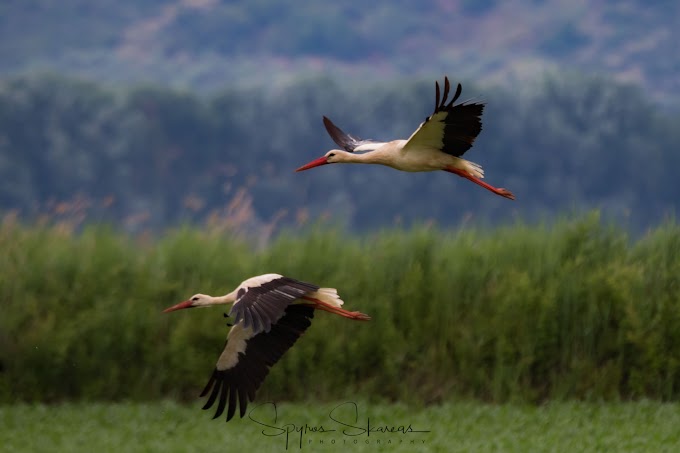
The plain close to Erythres village is the only place in Attica where one can see breeding White Storks and Lesser Kestrels. The habitat is also ideal for Quail, Corn Bunting and other arable farmland species. 

Friday, March 08, 2013

Garganey arrival

The first Garganeys are here! Among a flock of c.50 Teals, three Garganeys (including a male) were seen in Lake Koumoundourou, west of Athens. 

Other interested sight was the group of 17 Ferruginous Ducks, having with them one female Pochard...


Friday, March 01, 2013

The Jays of Mt Hymettus


Mt Hymettus lacked any Jays until the late 1990s. Then, a huge wildfire burnt most of the forests of Mt Penteli which is a few kms north of Hymettus. It seems that a large part of Penteli's Jays had to relocate. Nowadays, Jays of Mt Hymettus are mostly found in the northern, more wooded, parts. They can find their favourite acorns from the large number of Kerm and Holm Oaks (evergreen bushy oaks). 

Tuesday, February 26, 2013

Slender-billed beauty


Slender-billed Gull is for most Europeans a rarity. Fortunately it is not rare in Athens in winter, where it can be easily seen in Oropos Lagoon and Vourkari Bay. Adults, especially when the acquire the pinkish breast, are really beautiful birds!

Thursday, February 21, 2013

Winter's not done yet...

Even though the first spring visitors have already arrived (House Martin, Ruff, Swallow, Hoopoe) most of the winter visitors are still here and won't leave till late March.


Reed Buntings have changed plumage but are still found in good numbers in wetlands around Athens, like Vravrona.


A juvenile Black Kite stayed for the winter in the Mesogeia Plain, east of Athens. The bird roosted close to the airport, foraging the adjacent areas of Loutros, Loutsa and Vravrona. A very rare sighting for the Athenians, this was the first wintering record.

Monday, February 18, 2013

Spring alive! (even if it's still February)

The first wave of migrants has already reached Greece! Today, 40 House Martins were flying overhead Vravrona wetland, while single Hoopoes have been seen in Athens, along with solitary Swallows! 


House Martins are well known for being the first to arrive, but this time they broke all the records; the first was seen before the 10th of February! Hoopoes were also very early, while the Swallow record is also very unique! It's going to be a very "hot" spring...


Friday, February 15, 2013

February Trip to Evros Delta, Part III: Unexpected encounters...

 Among the numerous birds seen in and around Evros Delta, one was completely unexpected...

A Barn Owl was seen at broad daylight, a very rare sighting, even for Evros!
And that wasn't the only surprise. In early afternoon, at Paloukia lagoon a jackal was found right out in the open, quickly vanishing in the dense cover...

Jackals are quite unusual sighitings in Evros Delta, let alone see them at daylight...

Tuesday, February 12, 2013

Trip to Evros Delta Part II: Waterfowl and others...

 Thousands of White-fronted Geese and Swans, along with the usual attractions (Spoonbill, Dalmatian Pelican, etc) were among the more than 80 species seen in just a few hours...

White-fronted Goose is the commonest winter visitor
Whooper Swans were abundant this year
Dalmatian Pelicans are common and regular in winter

Spoonbills are also very easy to see


Sunday, February 10, 2013

Trip to Evros Delta (6-7 Feb.2013) Part I: Raptors

Early February in Evros is just fantastic. Waterfowl are still there in numbers of many thousands, and all the raptors of the area are visiting the area, from Merlins to White-tailed Eagles.

Hen harriers are always seen flying low in open areas

Merlins are regular winter visitors in the grasslands. 

The long-legged Buzzard is common resident in the hills surrounding the Delta

More than 70 Marsh Harriers can be seen in a single day in winter...

Great Spotted Eagles are the commonest of the large raptors, seven were seen in  a small area


Related Posts with Thumbnails